
What Local Data Center Deals Reveal About Mark Cuban’s Framework
By Ben Newman, Policy Frameworks. Sept. 8, 2026.

Mark Cuban called on X for a shared agreement communities could use to negotiate with data center developers. Later that day, he compiled an initial 10-point framework, drawing on hundreds of comments and discussions, covering issues including water use, noise, public payments and the cost of closing a facility. Business Insider reported on the framework and his call for towns to secure protections before approving projects.
How much of Cuban’s framework has already made it into local agreements, and where have communities accepted different terms?
We looked through the Policy Frameworks collection for agreements in which communities negotiated payments, water protections or financial commitments from data center developers. In them, we found precedent for his proposals and contradictions.
Cuban’s Framework
In his X thread, Cuban asks towns to address ten issues before committing to a data center project:
- Independent advice. Give the town its own legal and technical advisers, with developer funding where the law allows.
- Site suitability. Assess the full development and its effects on nearby communities before negotiating benefits.
- The right documents. Put protections in the relevant permits, ordinances, contracts and utility agreements.
- Water use. Set limits based on available supply, with a written plan for drought restrictions and public reporting.
- Noise. Study existing conditions and establish standards before equipment is ordered, including protections against low-frequency noise.
- On-site generation. Address routine power generation separately from emergency backup, including emissions and operating limits.
- Electricity and public costs. Establish who pays for new infrastructure and who bears the cost if a project slows or closes.
- Public return. Evaluate taxes and negotiated payments alongside incentives and public expenses.
- Financial backing. Secure funding for obligations before construction, operation or other activities create the expense.
- Phased approval and closure. Tie later phases to compliance and infrastructure capacity, and fund a plan for eventual closure.
The five examples below show how communities have addressed these issues in local agreements and proposed terms:
In Festus, Missouri, Community Payments Depend on a Tax Break
Cuban proposes calculating what a community will receive after subtracting tax incentives and public costs. In Festus, the developer’s community payments depend on a tax break.
The city’s infrastructure agreement sets payments at $3 million a year for the first five tax-abatement years and $5 million a year for the next five. That totals $40 million over the full schedule. If the project does not receive the specified personal-property tax abatement, those community payments are not due.
To calculate the public benefit, residents would need to know how much tax revenue is forgone and what the project costs the city, as well as how much the developer pays. The $40 million schedule supplies only the payment side of that calculation.
Under the same agreement, the first payment is due within 60 days after construction begins. A separate contribution toward a fire station is capped at $5 million.
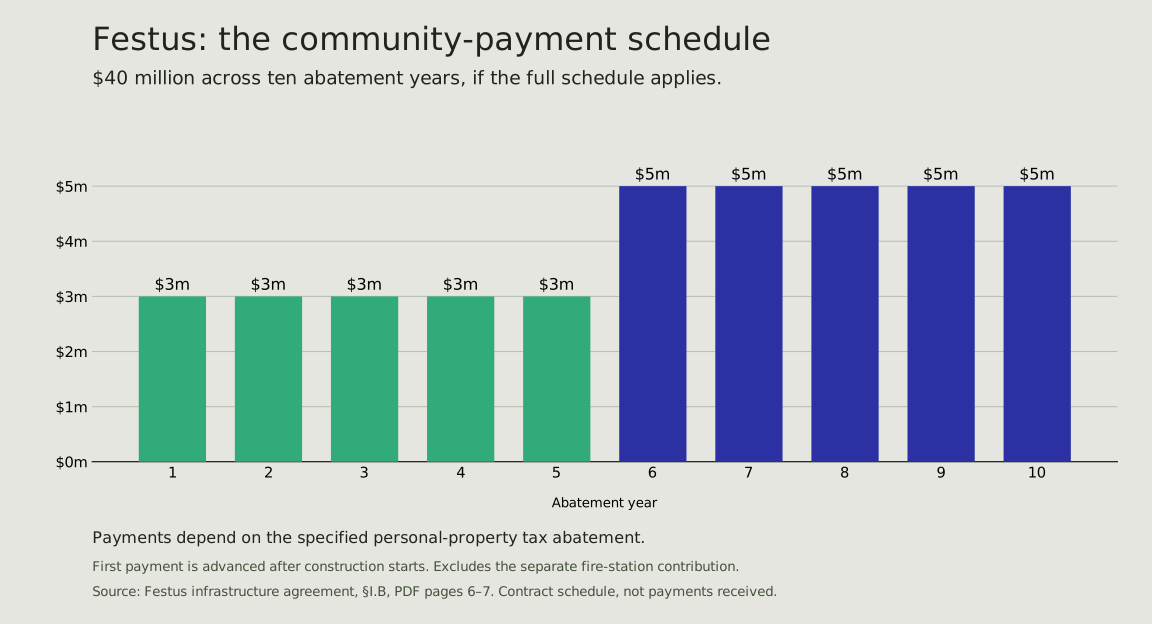
The chart shows payments required if the tax-abatement conditions apply. The first payment is advanced after construction begins. The total excludes the fire-station contribution and the cost of incentives. Actual payments received were not verified.
In Piqua, Ohio, the Water Agreement Protects Residents and the Project’s Supply
During a drought, Cuban proposes reducing water used for industrial cooling before restricting household use. Piqua’s water agreement gives priority to public health and safety when the city or county declares a shortage, including residential users, public services and health care facilities.
But it also promises the data center a dependable supply. The city can reduce water below the agreed service levels only when necessary to provide drinking water for the imminent protection of public health and safety, with reasonable notice to the customer. Restrictions on residential and commercial irrigation are expected before cuts to industrial use.
Piqua anticipates restricting some household uses before the data center’s supply. That differs from Cuban’s proposed sequence and shows why a community would need to specify which water uses it intends to protect.
In Goodyear, Arizona, a Deposit Backs Water Infrastructure Construction
For construction, cancellation and closure, Cuban wants financial backing in place before costs arise. A published amendment for Microsoft’s development specifies a $5 million deposit before a phase-three building permit and requires funds held in escrow to cover at least 110% of the cost of defined water-related improvements.
The escrow would fund those improvements, with a 10% allowance above their estimated cost and additional funding from the owner when required.
Cuban also calls for funding to close and remove a facility. This deposit is designated for water infrastructure; it does not establish funding for campus removal. The public agenda copy has blank signature fields and does not confirm that the deposit was made.
In El Paso, Texas, the Tax Agreement Limits the City’s Remedies
Cuban recommends preserving other lawful remedies when a developer fails to meet its obligations. El Paso’s tax-abatement agreement with Wurldwide LLC, by contrast, generally limits the city to terminating the agreement for the affected phase after notice and an opportunity to fix the breach.
Under section 6.9, the company generally would not have to repay tax breaks already received. The contract makes exceptions, including repayment when specified investment or completion commitments are missed and the city terminates on those grounds.
Ending a tax break can stop future benefits to the developer. Recovering benefits already granted is a separate question, and this contract restricts when that can happen. Those limits depart from Cuban’s recommendation to retain other lawful remedies. They apply to this tax-abatement agreement; they do not describe every right the city may have under other contracts or laws.
In St. Louis, Missouri, Permit Conditions Call for a Separate Community Agreement
Under Cuban’s proposal, protections would be spread across the documents that govern a project, including permits, utility contracts and community benefits agreements. In St. Louis, the city has published permit provisions alongside terms for a future community benefits agreement.
The permit provisions require a recorded CBA, while the separate document describes commitments intended for it. Residents would need the completed agreement to see which terms the parties ultimately accepted.
Local documents already contain provisions addressing several of Cuban’s proposals. They also show choices that a model agreement would have to make: whether community payments depend on tax incentives, which water uses take priority during a shortage, what expenses a developer’s deposit covers and what the community can recover if promises are broken.
Help Develop an Agreement Communities Can Adapt
Policy Frameworks is building an open standard for data center community benefit agreements with contributions from experts and communities alike. We’ll use AI and expert review to develop an evolving agreement any community can adapt.
People who negotiated or have lived with these agreements can help explain how the provisions worked in practice and what they would change.
Contribute to the Open CBA or browse the agreement collection.
This analysis was prepared independently by Policy Frameworks. Cuban has not submitted to or endorsed the project. The examples examine published terms in several types of project documents. We have not verified delivery of the benefits described or assessed the legal enforceability of the provisions.